
25.04.2023
News
17.04.2023
12.09.2022
02.09.2022
30.08.2022
29.08.2022
24.08.2022
22.08.2022
19.08.2022
18.08.2022
16.08.2022
12.08.2022
09.08.2022
08.04.2022
04.04.2022
31.03.2022
22.03.2022
07.03.2022
01.03.2022
14.02.2022
11.02.2022
18.01.2022
17.01.2022
15.12.2021
06.12.2021
29.11.2021
22.11.2021
28.10.2021
17.10.2021
05.10.2021
21.09.2021
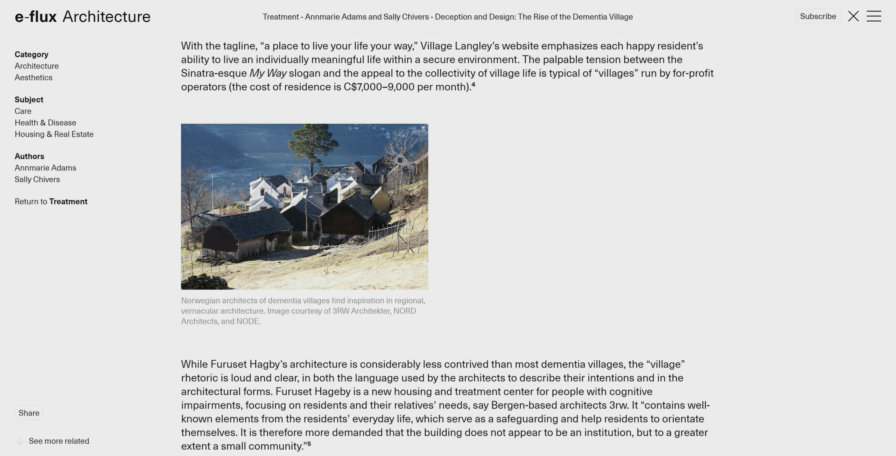
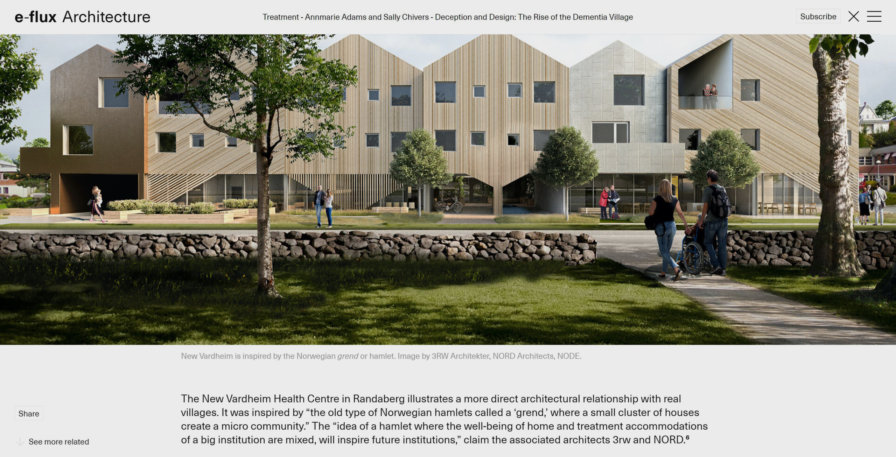
A short article by scholars Annmarie Adams and Sally Chivers refers to two architectural designs by 3RW and Nord Architects in support of their analysis of the “dementia village” typology. Cited works at Randaberg and Furuset reflect the complex combination of residential, commercial, and public buildings which corresponds to this typology.
In the words of the authors, “dementia villages are evidence of two historical phenomena significant to the history of architecture. Firstly, the rise of the dementia village illustrates the ongoing power of the “village” trope as a caring environment. Dementia-village architecture draws on the imagery associated with pre-industrial small towns, with pedestrian-friendly circulation, family-centered houses, and shared communal spaces. […] Secondly, the dementia village showcases an urge to camouflage serious illness by making healthcare environments that look like something else. This same trend is illustrated by hospital design since about 1980, which echoes hotels, shopping malls, and even airports.”
Take the example of Furuset: the layout of the residents’ facilities allows for a homey atmosphere, without the double-loaded and crowded corridors that characterize traditional plans of nursing homes. The private rooms are divided into smaller clusters with eight rooms in each, while corridors and common areas are placed towards the courtyard and outdoor facilities, allowing routines to become a natural part of the environment. As noted in “Deception and Design: The Rise of the Dementia Village”, these are architectural strategies that are purposefully anti-medical – medical care is here disguised.
Read the integral article on e-flux here.
Similar projects from 3RW and Nord include a village-inspired proposal for a nursing home in Olsrød.
10.09.2021
30.08.2021
27.08.2021
12.08.2021
11.08.2021
02.08.2021
30.06.2021
16.06.2021
04.06.2021
28.05.2021
22.04.2021
26.03.2021
17.03.2021
03.02.2021
01.02.2021
21.01.2021
19.01.2021
17.12.2020
16.12.2020
19.11.2020
15.11.2020
13.11.2020
12.11.2020
28.10.2020
27.10.2020
26.10.2020
19.10.2020
10.10.2020
18.09.2020
17.09.2020
11.09.2020
19.08.2020
12.08.2020
18.06.2020
12.06.2020
08.06.2020
05.06.2020
01.06.2020
26.05.2020
04.05.2020
29.04.2020
18.04.2020
17.04.2020
25.03.2020
18.03.2020
18.03.2020
28.02.2020
25.02.2020
24.02.2020
14.02.2020
31.01.2020
22.01.2020
16.01.2020
07.01.2020
05.01.2020
09.12.2019
07.12.2019
21.11.2019
21.11.2019
18.11.2019
12.11.2019
06.11.2019
05.11.2019
01.11.2019
21.10.2019
21.10.2019
16.10.2019
15.10.2019
10.10.2019
30.09.2019
18.09.2019
05.09.2019
29.07.2019
03.07.2019
06.06.2019
20.05.2019
15.05.2019
05.05.2019
02.05.2019
25.03.2019
22.03.2019
20.03.2019
14.03.2019
13.03.2019
12.03.2019
09.03.2019
04.03.2019
28.02.2019
10.02.2019
01.02.2019
20.01.2019
19.01.2019
10.01.2019
14.12.2018
07.11.2018
01.11.2018
26.10.2018
25.10.2018
11.10.2018
10.10.2018
09.10.2018
07.10.2018
06.10.2018
05.10.2018
29.09.2018
25.09.2018
29.08.2018
11.08.2018
07.08.2018
03.08.2018
24.07.2018
02.07.2018
13.06.2018
12.06.2018
07.06.2018
05.06.2018
05.06.2018
04.06.2018
01.06.2018
29.05.2018
25.05.2018
11.05.2018
04.05.2018
01.05.2018
23.04.2018
20.04.2018
15.04.2018
05.04.2018
02.04.2018
23.02.2018
21.02.2018
15.02.2018
08.02.2018
29.01.2018
25.01.2018
22.12.2017
21.12.2017
27.11.2017
25.11.2017
08.11.2017
03.11.2017
31.10.2017
25.10.2017
11.10.2017
06.10.2017
03.10.2017
30.09.2017
05.09.2017
02.09.2017
01.09.2017
10.08.2017
07.08.2017
03.08.2017
06.07.2017
01.07.2017
22.06.2017
16.06.2017
04.06.2017
24.05.2017
05.05.2017
03.05.2017
19.04.2017
05.04.2017
03.04.2017
20.03.2017
17.03.2017
10.03.2017
16.02.2017
03.02.2017
15.12.2016
03.12.2016
31.10.2016
26.10.2016
26.10.2016
01.08.2016
15.07.2016
14.06.2016
14.06.2016
13.06.2016
08.06.2016
31.05.2016
12.05.2016
30.04.2016
21.04.2016
16.03.2016
14.03.2016
02.03.2016
16.02.2016
10.02.2016
10.02.2016
10.02.2016
10.02.2016
10.02.2016
28.01.2016
17.01.2016
15.01.2016
11.01.2016
10.01.2016
15.09.2015
15.09.2015
27.08.2015
29.07.2015
08.07.2015
07.07.2015
05.07.2015
28.05.2015
28.05.2015
13.05.2015
13.05.2015
11.05.2015
11.05.2015
10.05.2015
08.05.2015
05.05.2015
05.05.2015
05.05.2015
05.05.2015
30.04.2015
28.04.2015
16.04.2015
16.04.2015
16.04.2015
10.04.2015
07.04.2015
25.03.2015
24.03.2015
23.03.2015
07.02.2015
07.02.2015
07.01.2015
01.01.2015
02.12.2014
28.11.2014
11.11.2014
10.11.2014
13.10.2014
07.10.2014
25.09.2014
22.09.2014
10.09.2014
21.08.2014
20.08.2014
18.07.2014
08.07.2014
03.07.2014
25.06.2014
20.06.2014
17.06.2014
11.06.2014
01.06.2014
25.04.2014
11.03.2014
04.03.2014
04.03.2014
27.02.2014
26.02.2014
21.02.2014
20.02.2014
18.02.2014
17.02.2014
31.01.2014
28.01.2014
19.12.2013
19.12.2013
18.12.2013
18.12.2013
20.11.2013
18.11.2013
11.11.2013
08.11.2013
31.10.2013
30.10.2013
25.10.2013
06.06.2013
05.04.2013
29.06.2012
